




AI Integration Services
Move beyond fixed logic and build a product that perceives, responds, and evolves in active use.
AI Intelligence Built Into the Core
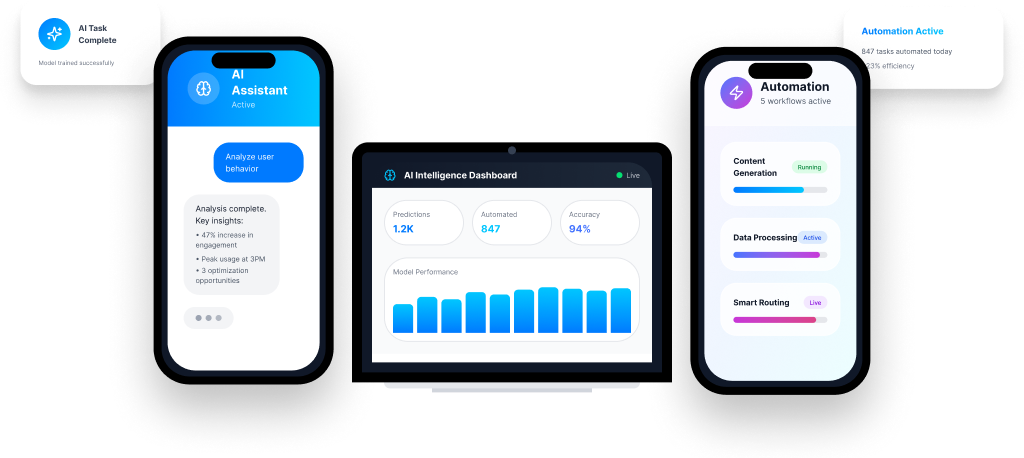
AI integration services make more sense when intelligence is not treated as an added feature, but as part of the product’s core logic. At Anka Diversify, we design and embed intelligence directly into the product so it can process inputs, automate decisions, and operate with more precision as it scales.
Our Pillars of AI Integration
AI Automation Solutions
We develop AI automation solutions that reduce manual effort and improve how the product operates.
- Task Automation
Machine Learning Integration
We implement machine learning integration where the product needs to learn from data and improve decisions over time.
- ML Model
GPT Integration Services
We build GPT integration services for products that need more dynamic interaction, generation, and response.
- GPT Response
Intelligent Automation
We structure intelligent automation into the product where actions need to be triggered with more speed and precision.
- Smart Actions
Why AI Integration Creates Value
AI integration services make the product more responsive and operationally aware over time. Intelligence is structured with business consequences in mind, not novelty.
More capable product behavior
AI integration services make the product more responsive and operationally aware over time.
Stronger implementation value
AI implementation services improve how intelligence is applied inside the product, not just added to it.
Less manual dependence
AI automation solutions reduce repeated effort and support faster, more consistent execution.
Smarter decision systems
AI product development strengthens how the product interprets data and acts on it.
Better long-term relevance
Products with embedded intelligence are better positioned to improve as usage and expectations evolve.
Integrating AI into Execution
The product starts reading more than inputs
AI integration services shape how the system interprets signals, handles decisions, and responds with more awareness.
Repetition starts giving way to automation
AI automation solutions reduce manual handling across the product, allowing routine actions to move with more consistency.
The system starts learning from what it sees
Machine learning integration improves how patterns are recognized, how behavior is interpreted, and how responses become more informed over time.
Interaction starts becoming more intelligent
GPT integration services make space for more dynamic responses, stronger assistance, and product experiences that feel more capable in use.
Execution starts operating with more autonomy
With intelligent automation built into the system, the product begins to handle more complexity with less manual dependence.
Why Businesses Choose Anka
Product Development
Technical Excellence
We treat AI as part of the product logic, not an added layer.
Our decisions are shaped by utility, precision, and long-term fit.
We work selectively, which keeps implementation sharper and more focused.
Intelligence is structured with business consequences in mind, not novelty.
The result is a product that becomes more capable without becoming harder to manage.
Our Approach to New Partnerships
We approach new partnerships with care, looking closely at the product, the business, and the direction it needs to take.
Initial Review
We begin by reviewing the product, its current behavior, and where intelligence could improve how it operates.
Scope Assessment
We assess the priorities, workflows, and technical conditions surrounding the engagement and any AI implementation services it may require.
Strategic Consideration
We evaluate where automation, model behavior, and decision logic should be introduced to support the product more effectively.
Partnership Selection
We move forward selectively, shaping the engagement around what the product actually needs and what can be integrated well.
Structured Onboarding
We begin with clear onboarding that establishes priorities, technical direction, and the pace of implementation.
Is Your Product Ready to Think More Intelligently?
AI integration services change what a product can take on, how it supports users, and how much manual effort it removes. If that shift is becoming part of your next stage, let’s talk about how to build it in properly.
Frequently Asked Questions
AI integration services usually include the systems, workflows, and decision logic needed to bring intelligence into the product itself. When working with us, that can involve AI implementation services, AI automation solutions, machine learning integration, and GPT integration services structured around how the product is meant to operate.
AI integration services usually become necessary when the product starts handling more complexity than fixed logic can support well. That often happens when teams need better automation, more adaptive behavior, or stronger decision-making inside the product as it scales.
We approach AI implementation services by looking at where intelligence can improve product behavior without creating unnecessary complexity. That means understanding the current system, identifying where intelligence belongs, and integrating it in a way that supports the product rather than disrupting it.
These systems help products handle repeated actions, decisions, and workflows with more consistency and less manual involvement. When applied properly, they improve operational efficiency while also making the product more capable in active use.
It is the right fit when the product needs to learn from data, detect patterns, or improve outputs over time. It becomes especially valuable when product behavior should become more informed through usage rather than staying tied to fixed rules.
They support products that need more dynamic interaction, language-based assistance, content generation, or intelligent response layers. The key is making that behavior useful inside the product experience, not simply adding AI for visibility.
Yes. AI product development can be shaped from the beginning when intelligence needs to influence how the product behaves at a foundational level. We also support products that already exist and need intelligence introduced more deliberately as the next stage of growth.
Our AI integration services are structured around the product’s core logic, not surface-level additions. That leads to stronger fit, better implementation discipline, and a product that can make better use of intelligence over time.
Yes, when it is structured properly. Intelligent automation should reduce strain, not add it. The goal is to make the product more capable while keeping the system clear enough to maintain, refine, and scale.
If you need AI integration services shaped with stronger product judgment, clearer implementation logic, and more control over how intelligence enters the system, we are likely the right fit. This work is best suited to teams that want useful intelligence built into the product, not added for appearance.